More Fair Work Changes for Better or Worse

More Fair Work Changes for Better or Worse

Latest News & Events

More Fair Work Changes for Better or Worse

money changing hands

The last 5 years have seen more changes to employment and related laws than at any time in history and the Albanese Government isn’t finished. A new Fair Work Bill has just hit parliament and AI, unfair dismissal and general protections claims, multi-enterprise agreement and road contractors all feature in the mix. What’s happening, why is it happening and what are the potential impacts? 

Background

On 3 June 2026, the Federal Government presented the Workplace Relations Legislation Amendment (Building Cooperative Workplaces No. 1) Bill 2025 to the House of Representatives.

It provides for a number of changes to:

  1. Fair Work Commission rules and processes because of the high quantity and low integrity of AI generated claims of unfair dismissal and general protections and their impact on efficiency of FWC operations.  
  2. A streamlined and mandatory process for supported bargaining authorisations to be issued following expiry of a previous supported bargaining enterprise agreement.
  3. The high income threshold for access of road transport contracts to the Fair Work Commission’s unfair contract termination claims jurisdiction. 

And there are some new processes being introduced whereby the Fair Work Commission will have the ability to determine claims “on the papers” and to ban vexatious claimants (repeat offenders) from making any claim without the specific approval of a Presidential Member of the Commission.

Plus some of the changes have significant implications for employers and warrant consideration of ways to mitigate any related negative effects. 

Jurisdictional issues

One of the bottlenecks that the Fair Work Commission has noted is when there is a jurisdictional objection to a claim eg on the basis that the applicant isn’t eligible to make a claim and/or it is not within the Commission’s jurisdiction to deal with the application.

This can commonly be about whether the applicant is actually an employee or has sufficient service to qualify as eligible to make a claim or was dismissed on prohibited grounds.  

These jurisdictional questions have had to be dealt with before the application itself is dealt with. This Bill proposes to flip that. 

This change is that the Fair Work Commission would not deal with jurisdictional arguments – an employer would have to prosecute that objection in the Federal Court or the Federal Circuit Court and that is expensive.

Another effect is that the applicant is essentially guaranteed a hearing either on the papers or at conciliation by virtue of the fact that they made the application and regardless of their actual eligibility to do so. 

Decisions “on the papers”

The Bill provides for a new power for the Fair Work Commission to determine matters on the papers provided that it is satisfied that the matter is one that can be adequately determined in the absence of the parties and both parties agree to “on the papers ” determination,

Applications re unfair dismissal (employees), unfair termination (road transport contractors) and unfair deactivation (gig workers) are all in the mix here but we could see this facility extended to other areas of the Fair Work Commission’s work. 

This really does mean that employers need to consider whether their interests are best served by “on the papers” determination or going through conciliation and, if necessary, arbitration processes.

Is it a vexatious claim that should be thrown out “on the papers” or is it something where there is greater risk requiring the opportunity to negotiate a settlement?

It also really does mean that you need to make sure that “the papers” are properly prepared if they are going to be the basis for determination.

Frivolous and vexatious claims

The massive increase in applications, a significant proportion of which have been generated via AI by unrepresented applicants has caused the Fair Work Commission to look at ways to reduce the incidence of these “frivolous and vexatious claims”.

The legislation provides the Commission with a new ability to issue a binding order prohibiting an applicant who has had an application dismissed on the basis that it is frivolous, vexatious or possesses absolutely no reasonable prospect of success from making  similar claims in the future without the express and prior permission of a Presidential member of the Commission to do so.

Separately, the Fair Work Commission has made significant changes to application requirements specifically to minimise the impact of AI on claim numbers and to help to identify and dismiss frivolous and vexatious claims.  

Multi-employer bargaining

The Fair Work Commission can issue supported bargaining authorisations designed to enable multiple employers within a low paid industry to be drawn into a collective bargaining process by a union.

This Bill includes a mandate for the Fair Work Commission to issue a new supported bargaining authorisation to negotiate a new enterprise agreement for a workforce that was previously covered by a supported bargaining enterprise agreement.

That will happen if the application is made no earlier than three months prior and no later than two years after the nominal expiry date of the prior agreement and the new process features the same or substantially the same employer and employee cohorts as was the case with the prior agreement.

This makes it more difficult for an individual employer to cut themselves free from a cyclical multi-employer agreement process on an ongoing basis.

Access for regulated road transport contractors

Under the Closing Loopholes suite of legislative changes, road transport contractors were granted access to the Fair Work Commission for claims of unfair termination or deactivation of contracts, provided that their remuneration was less than the High Income Threshold which, at the time of writing, was $183,100 (moving to $190,100 from 1 July 2026).

This is the same as the threshold set for eligibility to make unfair dismissal claims by employees.

There has been a realisation that road transport contractors incur a lot of costs in generating their income that employees do not. As a result, the High Income Threshold for road transport contractors needs to be determined differently.

The Bill doesn’t state what that will look like but perhaps some guidance might be taken from the Victorian Owner Drivers and Forestry Contractors Act 2005 and how that is applied in practice. You can find a wide range of resources on the Business Victoria website including costs schedule for different categories of vehicles that are updated annually.

What’s that all mean for you?

Our key takeaways:

  • We don’t expect that the Government will have any difficulty in getting the legislation passed so, if any of these issues resonate for your business, start addressing them.
  • If you don’t have one, find an experienced workplace relations advisor who can help you to get the processes right pre-termination and post-termination to minimise exposures in unfair dismissal and general protections complaints.
  • If you receive a frivolous or vexatious claim or one that you think doesn’t qualify, don’t bother trying to run a jurisdictional argument – try to get it dismissed or settled either on the papers or in conciliation.
  • If you are in a designated low paid industry, explore the option of having your own enterprise agreement which would protect you from being dragged into a supported bargaining authorisation and multi-employer agreement.
  • If you utilise road transport contractors in your supply chain, review your contracts for rates and terms including termination provisions to identify any potential risks from the expanded Fair Work Commission coverage that will be coming. You might also visit Business Victoria and check out their resources for owner drivers.

And, if you need a hand, just reach out – call 0438 533 311 or fill out the “Tell us what you need help with” form below.


CONTACT US

Ridgeline Human Resources Pty Ltd
ABN : 24 091 644 094

enquiries@ridgelinehr.com.au

0438 533 311

PARTNER LINKS

TELL US WHAT YOU NEED HELP WITH

Our HR Triage Service

Our HR Triage Service

Latest News & Events

Our HR Triage Service

money changing hands

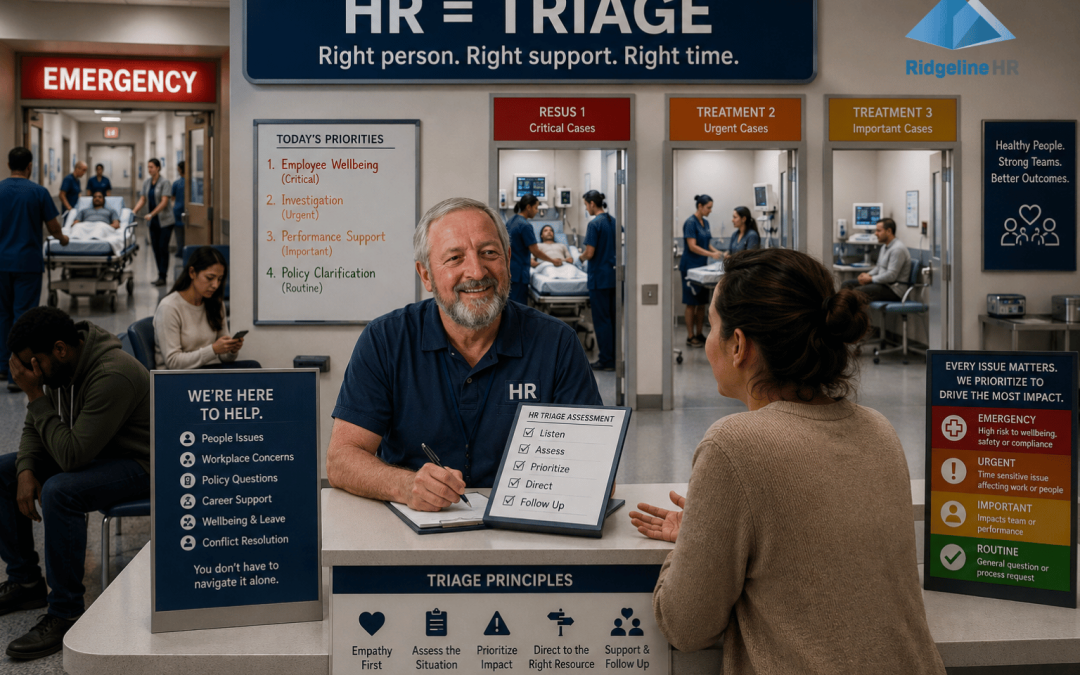
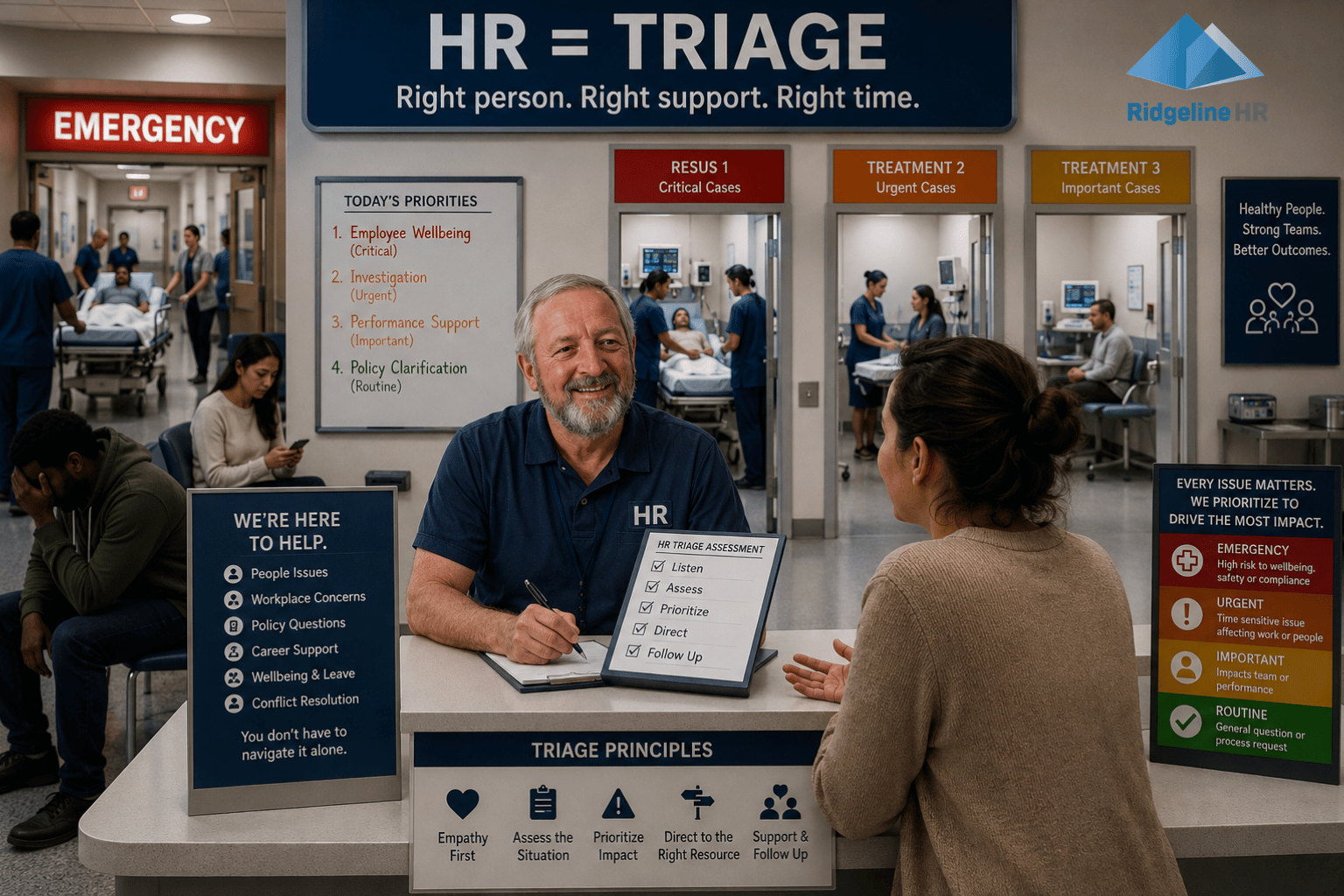
Do you need assistance with an HR issue but don’t know where to go? Should you go to the Fair Work Ombudsman or to an employment lawyer or a workplace health and safety specialist or a HR consultancy? Need someone to help you find the right option for your business and your circumstances? That’s where our HR Triage Service comes in. 

What’s the problem?

We have been helping organisations of all sizes and industries with HR matters for 26 years and there are a few key lessons that we have learned along the way:

  1. Employment and safety law and modern awards and related employer obligations and exposures get more complex and harder to manage every year.
  2. That’s just gone up a notch with the introduction of positive duties in relation to psychosocial hazards and sexual harassment and gender-based behaviour plus the emergence of hybrid working in recent years.
  3. Similarly, areas which in the past might have been seen as specific to WHS or to HR or to zones like equal opportunity are now crossing multiple jurisdictions requiring multi-faceted and integrated management.
  4. And, of course, people have an amazing capacity to give us surprises and new challenges to address which is added to by the creative capacity that AI brings to the conversation.
  5. Plus there are all of the challenges that people have today in a less secure world with political upheaval, global tensions, mental health and financial stress adding to the mix.

And we know that the pace of change just gets faster and faster.

All of that gives rise to a difficult question for SMBs: “Where do I go to access the support that I need for the particular issue that I have in such a complicated landscape?” 

Trying to answer that question can be very costly in time, money and worry.

How can we best help?

Over the past year, we have undertaken a review of how we operate in helping our clients with the full range of HR needs (PEOPLE BUSINESS) as well as continuing to develop and deliver value through our PosWork suite of positive psychology based interventions and our new multi-media communications arm, Flashtales Creative.

With that review came the realisation that we have over many years developed a robust network of generalist and specialist service providers across the full spectrum of HR, WHS and related services – lawyers, consultants, mediators, injury management services and more.

One of the strengths that we have is our ability to diagnose the problem and identify the intervention options for the particular enquiry.

So, rather than try to be the everything HR service ourselves, it makes more sense for us to leverage our network and our diagnostic abilities to provide clients with the right service and connection. 

What’s in it for you?

You don’t have to waste your time and money searching for a solution to a need that you probably don’t fully understand yourself.

And you can rest easier knowing you can “phone a friend” to do that for you – call 0438 533 311 or fill out the “Tell us what you need help with” form below.


CONTACT US

Ridgeline Human Resources Pty Ltd
ABN : 24 091 644 094

enquiries@ridgelinehr.com.au

0438 533 311

PARTNER LINKS

TELL US WHAT YOU NEED HELP WITH

Sham contracting in the spotlight

Sham contracting in the spotlight

Latest News & Events

Sham contracting in the spotlight

money changing hands

Every few years, the subject of sham contracting gets regulators’ attention and those regulators often collaborate with each other across jurisdictions. The Australian Taxation Office and the Fair Work Ombudsman have jointly announced that they are doing just that. And the Albanese Government changed the rules on what organisations need to be doing to ensure that they don’t engage in sham contracting. How does that change things?

What is sham contracting?

According to the Fair Work Ombudsman, “sham contracting happens when an employer misrepresents to a worker that an employment relationship is an independent contracting arrangement when the employer doesn’t reasonably believe this. This might be done in an attempt to avoid paying entitlements such as super, leave and workers’ compensation. This practice undermines or ignores workers’ rights and disadvantages honest businesses. Those who engage in sham contracting can face court-ordered penalties.”

It might also be when a worker proposes engagement as an independent contractor for the purposes of avoiding taxation liabilities. 

From recklessness to reasonableness

As of February 2024, the legal test for defending a sham contracting claim was updated to a “reasonableness” test. To avoid penalties, the principal in the relationship must now prove that, at the time of the arrangement, they reasonably believed the worker was a contractor. This replaced the previous, more lenient “recklessness” test, making it harder for employers to defend against claims.

So now there is a much higher onus on businesses to properly consider whether an arrangement is really that of an independent contractor rather than that of an employee.

Income matching and reporting

The Taxable Payments Reporting System requires businesses who engage contractors providing services in certain industries to report those payments to the Australian Taxation Office.. The nominated industries are:

  • building and construction
  • cleaning
  • courier and road freight
  • information technology
  • security, investigation or surveillance.

If the revenue you receive from these services is 10% or more of total revenue, you are required to lodge a Total Payment Annual Report (TPAR) with the ATO.

If contracting businesses are generating a significant proportion of their revenue from one source, there will likely be a suspicion that it is a sham contracting arrangement. 

So what if you are found to be sham contracting

Under the Fair Work Act, courts can impose penalties against businesses or individuals for sham contracting. The maximum penalties for each contravention are:

  • $19,800 for individuals
  • $99,000 for businesses with fewer than 15 employees
  • for businesses with 15 or more employees, the greater of $495,000 or three times the underpayment amount.

Apart from the penalties imposed by the Fair Work Act, businesses who incorrectly treat an employee as an independent contractor risk other penalties and charges, including:

  • PAYG withholding penalty for failing to deduct tax from worker payments and send it to the ATO
  • super guarantee charge (SGC), which is more than the super that would have been paid if the worker was classified correctly. SGC consists of:
    • super guarantee shortfall amount
    • nominal interest
    • an administration fee
  • additional super guarantee penalties including the Part 7 penalty amount of up to 200% of the SGC under the Superannuation Guarantee (Administration) Act 1992.

A few pointers

  1. The fact that someone has an ABN doesn’t make them an independent contractor.
  2. If they are paid by the hour for doing work that an employee could do and there is an ongoing arrangement for the worker to continue to do that work (not just come in and do a finite job like servicing a machine or building a s structure), there would be exposure to a suspicion of sham contracting.
  3. The fact that it might be the worker who proposes the contracting arrangement does not relieve the principal of the legal responsibility to ensure that they reasonably believe the relationship to be a genuine independent contracting arrangement.
  4. The fact that a worker might have multiple ongoing contracts with different businesses does not necessarily mean that a valid contracting arrangement exists if they are personally performing all of the work under those contracts on a regular and systematic basis. They might actually be found to have multiple part-time jobs as employees. There has been a decision in the Fair Work Commission to that effect.
  5. If, other than the way that someone is paid ie by invoice rather than through payroll, the worker has the characteristics of an employee, the odds are that they really should be an employee
  6. Regardless of whether someone is engaged as a contractor if they are just or principally supplying their labour, they will likely be deemed to be an employee for the purpose of the superannuation guarantee. 

If you engage contractors, you should be assessing the relationships for genuineness in the legal context and there should be contracts for service which clearly set out the nature of the relationship and provide evidence of the worker’s genuine agreement to that contractual arrangement. Need a hand?  Send us a message through the “Tell us what you need help with” form below.

Note: much of the content in this blog is sourced from the websites of the Fair Work Ombudsman and the Australian Taxation Office.


CONTACT US

Ridgeline Human Resources Pty Ltd
ABN : 24 091 644 094

enquiries@ridgelinehr.com.au

0438 533 311

PARTNER LINKS

TELL US WHAT YOU NEED HELP WITH

Is this the death knell for labour hire?

Is this the death knell for labour hire?

Latest News & Events

Is this the death knell for labour hire?

money changing hands
Does the Fair Work Commission Full bench decision on “same job, same pay” and Regulated Labour Hire Arrangement Orders pose a threat to viability of labour hire providers?  

“We are satisfied that the evidence does not establish that the work of employees of OS Production and OS Maintenance involves the provision of an identifiable and discrete service to BMA as distinct from the supply of the labour of those workers to work in or as part of the business of the BMA.” 

And, with those words, a Full Bench of the Fair Work Commission determined that 2,200 labour hire workers working on 13 Queensland mining sites should get an average wage increase of about $30,000 per annum.

About “Same Job, Same Pay”

The Albanese Government introduced the Same Job Same Pay legislative changes specifically to combat organisations which had enterprise agreements with high wages and outsourced their labour requirements to reduce labour costs. They did so by using a labour hire organisation to employ their workers rather than directly employing them.

The “Same Job, Same Pay” amendments enable applications to be made to the Fair Work Commission to have the terms of the host’s enterprise agreement apply to the labour hire workers.

What that means is that, if such an application is successful, labour hire becomes a much less attractive commercial option as the host would be charged by the labour hire provider for the wages of labour hire workers at the same level that they would have to pay if they employed these people directly plus the labour hire provider’s on costs and service fees and profit margin.

Does this mean the end of labour hire?

Absolutely not.

“Same Job, Same Pay” only.affects circumstances where the labour hire firm’s customer has an enterprise agreement that would cover employees doing the same sort of work as the labour hire workers.

So for the vast majority of businesses, this is nothing to worry about – you can still use labour hire if you want to.

However, there is no question that businesses in the space that the “Same Job, Same Pay” changes are designed to address played a key role in the growth of labour hire as an alternative labour sourcing option.

So labour hire businesses which are heavily invested in that space are likely to feel the full impact of this decision.

Please call us on 0438 533 311 or email enquiries@ridgelinehr.com.au if you want to explore how we might be of assistance.


CONTACT US

Ridgeline Human Resources Pty Ltd
ABN : 24 091 644 094

enquiries@ridgelinehr.com.au

0438 533 311

PARTNER LINKS

TELL US WHAT YOU NEED HELP WITH

Offshore worker’s unfair dismissal claim allowed

Offshore worker’s unfair dismissal claim allowed

Latest News & Events

Offshore worker’s unfair dismissal claim allowed

example flexible working arrangement

Are you using offshore workers in the belief that they are not covered by Australia’s Fair Work system? Well, you might be right….but then again, you might not.

What has happened?

Deputy President Slevin at the Fair Work Commission has determined that an offshore worker in the Philippines deemed by her contract to be an independent contractor is actually an Australian National System Employee with access to our unfair dismissal jurisdiction.

The case of Ms Joanna Pascua v Doessel Group Pty Ltd involves a worker engaged to do paralegal work for a Queensland law firm which terminated her contract due to alleged breach of contract which was disputed by the worker and resulted in her lodging an unfair dismissal claim.

That led to a jurisdictional hearing as the respondent alleged (among other things) that she wasn’t an employee and so couldn’t be dismissed.

Here is the decision.

Why did the FWC make that determination?

In his decision, the Deputy President goes into quite a bit of detail on the terms set out in the written contract between the parties as well as the duties and working arrangements for the applicant and relevant case law.

One problem for the respondent was that, in parts, the contract referred to the other party as an employee or had provisions which would typically be associated with an employment arrangement.

The Deputy President also made note that the worker was more likely to be an employee because she worked inside the respondent’s business rather than providing services to the business from outside it. That perspective might be a bit of a red flag for the validity of many nominal independent contracting arrangements, whether local or overseas.

Reference was also made to KPIs that were set for the worker and to potential award coverage under the Legal Services Award 2020 with commentary that what the worker was getting paid ($18 per hour) was significantly below the award rate for the classification of work that she was performing as he saw it. Another red flag perhaps given the current federal government’s legislative changes to protect “employee-like workers” and provide the Fair Work Commission with the power to deal with complaints of unfair contractual terms from independent contractors.

The Deputy President concluded: “For the foregoing reasons I find that the relationship was an employment relationship. Accordingly, the Respondent’s objection is dismissed.” I would note that the foregoing reasoning was a lot more extensive than what I have set out above but hopefully my summary gives you the gist of the factors in play. 

What does it mean?

One of the things that has been repeatedly emphasised in the extraordinary range and number of changes that we are experiencing in our workplace relations system is that the focus going forward will be on the true nature of the relationship rather than just what is written in a contract

Another is to provide some level of security and protection and complaints jurisdictions for what have been called “employee-like workers”, those who might not be classified as National System employees because they are nominally not employees.

While we might not have expected that this would extend to offshore workers, this decision brings a whole new rage of considerations to bear in entering into offshore engagement arrangements.

One thing that is very clear from this case is that the poor drafting of the contract between the parties was a significant factor in the Deputy President’s considerations – he literally pulled it to pieces.

So any business entering into independent contractor arrangements whether locally or overseas needs to get professionally drafted contracts that don’t leave any doubt as to the relationship between the parties.

Another issue to consider which has been on our mind. Is one of the potential outcomes of a complaint to the Fair Work Commission re unfair contract terms by an independent contractor, a determination that the worker is a National System employee rather than a contractor? We reckon that might be on the cards. What do you think?

If you need any assistance with this or any other employment or related matter, please contact us on 0438 533 311 or by emailing us at enquiries@ridgelinehr.com.au

CONTACT US

Ridgeline Human Resources Pty Ltd
ABN : 24 091 644 094

enquiries@ridgelinehr.com.au

0438 533 311

PARTNER LINKS

TELL US WHAT YOU NEED HELP WITH

Are your contracts current, compliant and complete?

Are your contracts current, compliant and complete?

Latest News & Events

Are your contracts current, compliant and complete?

example flexible working arrangement

As we go through the biggest era of change in employment laws and modern awards that we have ever seen, it is becoming increasingly important to have written contracts that clearly set out the pay and conditions applying to each individual employee or contractor. Do yours? And are they current, compliant and complete? 

Why do you need written contracts?

When you engage someone to work for you, whether as an employee or a contractor, it brings into play a host of legal obligations covered by the Fair Work Act and a variety of other legislation and, in the case of employees, modern awards and, where applicable, enterprise agreements. 

There are many purposes that contracts serve:

  1.  They educate you about your legal obligations and can be a source of information for decision-making on issues that arise in the relationship with the employee or contractor.
  2. They clearly set out the nature of the relationship between you and the employee (be it full-time, part-time, casual or fixed term) or contractor.
  3. They provide details on any duties or obligations that the employee or contractor is required to satisfy in the relationship with you.
  4. They provide evidence of the employee or contractor acceptance of the pay and conditions as set out in the contract and, assuming the fairness of the contract, can be used in defence of any claim that might be made against you or your business.
  5. There have been around 70 changes in employment law and modern awards and the rules around employment and contracting have undergone an overhaul recently.

The gap between employee and contractor is progressively becoming more blurred so you also want clarity, especially if the individual is not covered by a company (Pty Ltd) structure.

What are the changes that affect contracts? 

Some of the significant changes that need to be considered in contracts are:

  1. New definitions of employee, casual employee and contractor
  2. Prohibition of pay secrecy provisions
  3. A new jurisdiction at the Fair Work Commission for disputes in relation to unfair contract claims
  4. New jursidictions for road transport contractors and gig workers
  5. The “right to disconnect” and associated award provisions
  6. Changes to rules in relation to annual shutdowns
  7. Revised casual conversion provisions
  8. New jurisdictions for dispute resolution at the Fair Work Commission regarding sexual harassment, requests for flexible working arrangements, requests for extension of parental leave and complaints regarding the right to disconnect

These are just a few of the issues that need to be considered in constructing contracts and their relevance may well vary according to the industry, business setting, occupation and seniority of the role in question. 

Other considerations

While under the changes that we are currently seeing, we are moving back to multi-factorial assessment of the true nature of a relationship (eg contractor or employee), the contract is still an important piece of evidence in determining such questions.

Remember that one size does not fit all and don’t just adopt a template that you got from somewhere else or that is the standard on the HR compliance system that you use. It is imperative that the contract is a fit with your business arrangements and with the individual concerned – ie ensure that they reflect the reality.

We have also seen a number of prosecutions of corporations in recent years for underpayment of wages related to employees being put on contracts with fixed salaries which did not provide adequate remuneration for the hours that those employees actually worked.

So, if you do want to put people on salaries or you wish to set off any award entitlements that might apply to an employee, you need to both be very specific in the contract about exactly which award provisions are being set off and compensated for by the remuneration provided for in the contract and you have to make sure that the employee is actually better off than they would be if the award was literally applied to their employment, pay and conditions.

Also a heads up if you have restraint provisions that the ACCC is currently considering whether restraint provisions should be regulated or, in some cases, abolished – so watch this space.

How we can help

We have been helping clients with employment contracts for over 20 years.

We can advise you on award coverage, terms in awards that affect remuneration or impose certain conditions and help you in structuring remuneration and benefits so that your offer is compliant.

We can help you to navigate all of the changes that are coming in so that your contracts are current.

And we can help you to decide the style of contract that you want in each case and what needs to go into them to make them complete for that particular circumstance.

If you would like to explore how we can assist you with employment contracts, call us on 0438 533 311 or email enquiries@ridgelinehr.com.au to arrange your free first consultation.

CONTACT US

Ridgeline Human Resources Pty Ltd
ABN : 24 091 644 094

enquiries@ridgelinehr.com.au

0438 533 311

PARTNER LINKS

TELL US WHAT YOU NEED HELP WITH