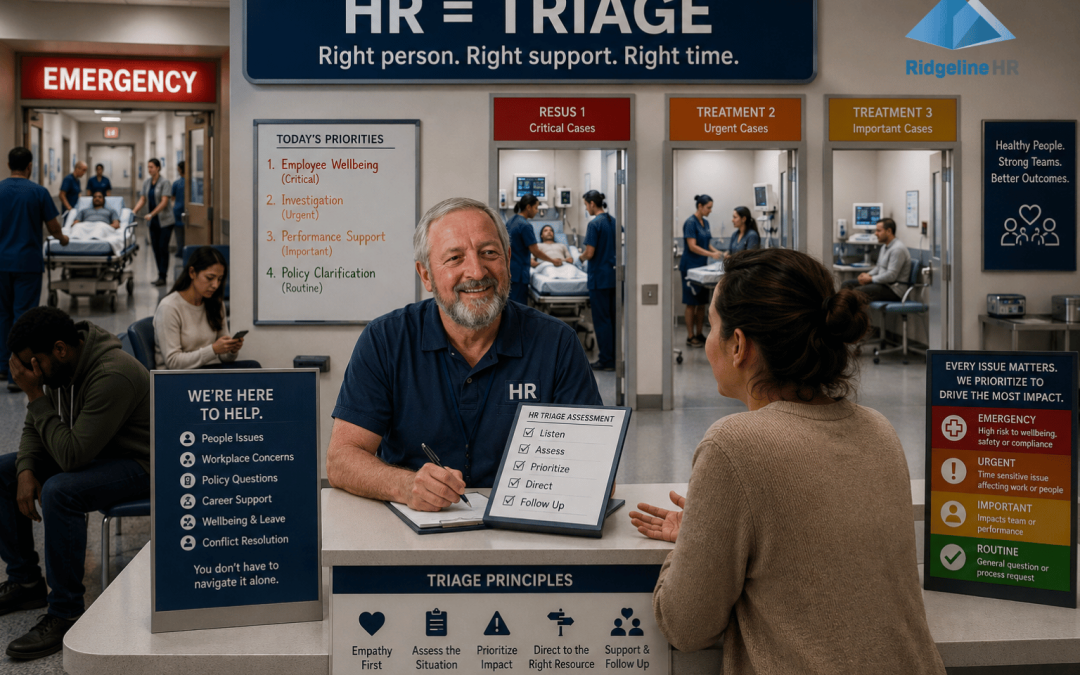
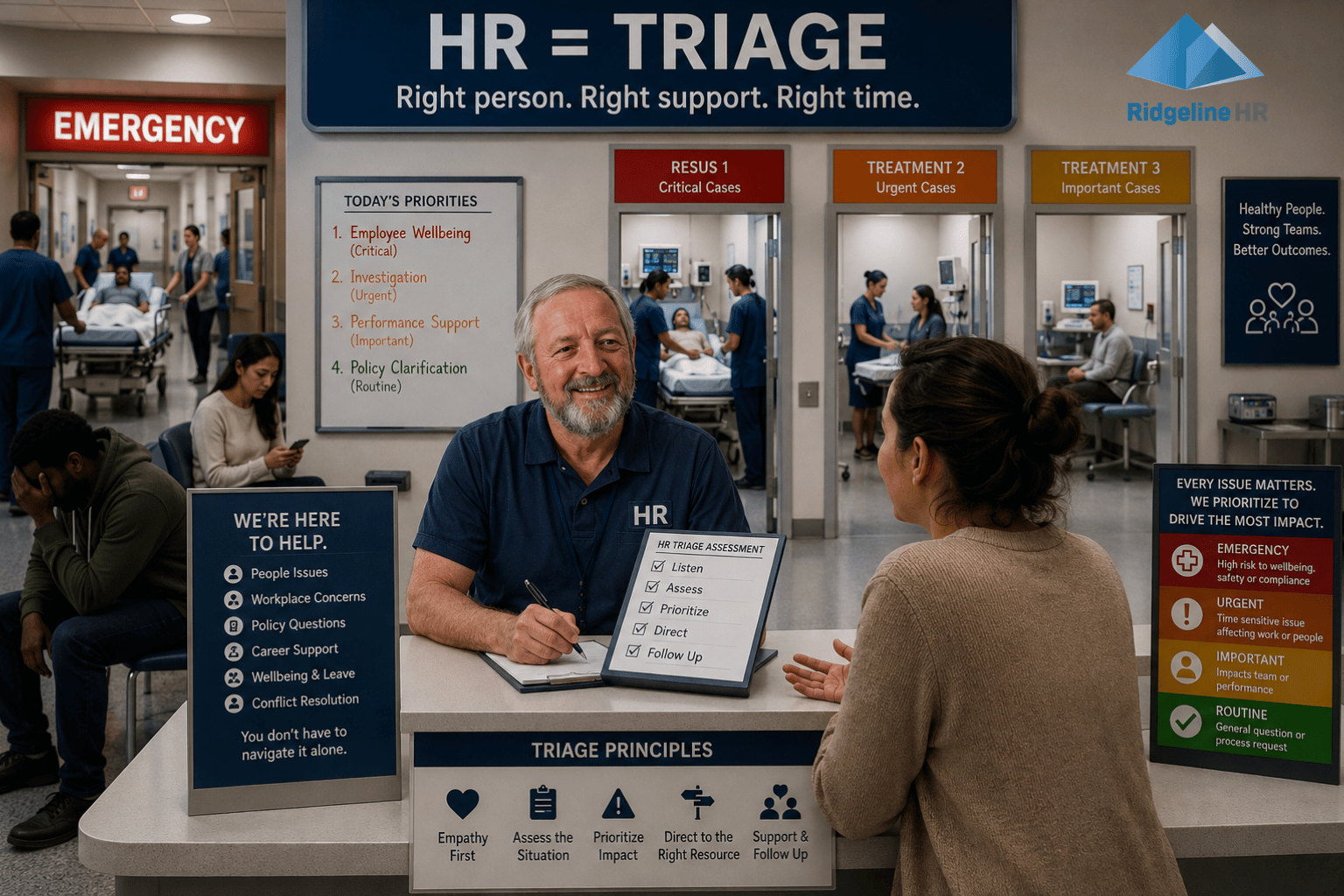
Our HR Triage Service

Our HR Triage Service

Latest News & Events

Our HR Triage Service
money changing hands

Do you need assistance with an HR issue but don’t know where to go? Should you go to the Fair Work Ombudsman or to an employment lawyer or a workplace health and safety specialist or a HR consultancy? Need someone to help you find the right option for your business and your circumstances? That’s where our HR Triage Service comes in. 

What’s the problem?

We have been helping organisations of all sizes and industries with HR matters for 26 years and there are a few key lessons that we have learned along the way:

  1. Employment and safety law and modern awards and related employer obligations and exposures get more complex and harder to manage every year.
  2. That’s just gone up a notch with the introduction of positive duties in relation to psychosocial hazards and sexual harassment and gender-based behaviour plus the emergence of hybrid working in recent years.
  3. Similarly, areas which in the past might have been seen as specific to WHS or to HR or to zones like equal opportunity are now crossing multiple jurisdictions requiring multi-faceted and integrated management.
  4. And, of course, people have an amazing capacity to give us surprises and new challenges to address which is added to by the creative capacity that AI brings to the conversation.
  5. Plus there are all of the challenges that people have today in a less secure world with political upheaval, global tensions, mental health and financial stress adding to the mix.

And we know that the pace of change just gets faster and faster.

All of that gives rise to a difficult question for SMBs: “Where do I go to access the support that I need for the particular issue that I have in such a complicated landscape?” 

Trying to answer that question can be very costly in time, money and worry.

How can we best help?

Over the past year, we have undertaken a review of how we operate in helping our clients with the full range of HR needs (PEOPLE BUSINESS) as well as continuing to develop and deliver value through our PosWork suite of positive psychology based interventions and our new multi-media communications arm, Flashtales Creative.

With that review came the realisation that we have over many years developed a robust network of generalist and specialist service providers across the full spectrum of HR, WHS and related services – lawyers, consultants, mediators, injury management services and more.

One of the strengths that we have is our ability to diagnose the problem and identify the intervention options for the particular enquiry.

So, rather than try to be the everything HR service ourselves, it makes more sense for us to leverage our network and our diagnostic abilities to provide clients with the right service and connection. 

What’s in it for you?

You don’t have to waste your time and money searching for a solution to a need that you probably don’t fully understand yourself.

And you can rest easier knowing you can “phone a friend” to do that for you – call 0438 533 311 or fill out the “Tell us what you need help with” form below.


CONTACT US

Ridgeline Human Resources Pty Ltd
ABN : 24 091 644 094

enquiries@ridgelinehr.com.au

0438 533 311

PARTNER LINKS

TELL US WHAT YOU NEED HELP WITH

Adult juniors to get adult wages

Adult juniors to get adult wages

Latest News & Events

Adult juniors to get adult wages

money changing hands

Lots of modern awards and enterprise agreements have junior rates of pay typically applying to workers who are under 20 or 21 years of age who don’t get a full adult wage for the work that they do. In a landmark decision, the Fair Work Commission has decided that that has to change for at least some of them.

About the case

On 6 June 2024, the Shop, Distributive and Allied Employees’ Association (SDA) applied to change junior rates, seeking to increase rates of pay for employees aged 20 years old and under in the following 3 awards:

  • Fast Food Industry Award 2020
  • General Retail Industry Award 2020
  • Pharmacy Industry Award 2020

Part of the rationale behind the application is that employees who are 18 years or older should receive full adult rates because they are treated as adults in so many other aspects of law and life. For example, when you reach 18 years of age, you can legally:

  • Vote in elections (you must enrol with the Australian Electoral Commission)
  • Stand for public office (with some age limits for certain roles)
  • Serve on a jury if called
  • Be treated as an adult in the legal system (no longer a minor)
  • Enter into legally binding contracts (leases, loans, phone plans, etc.)
  • Open and control your own bank accounts and finances independently
  • Buy and consume alcohol legally
  • Purchase tobacco products
  • Enter licensed venues like pubs and clubs without a guardian
  • Apply for a full (unrestricted) driver licence (after meeting state requirements)
  • Travel independently and apply for an adult passport
  • Get married without parental consent
  • Make your own medical decisions
  • Create a will
  • Be fully responsible for debts and legal obligations

It is a fairly compelling argument.

About the decision

The Full Bench has decided that:

  • after 6 months’ experience, the rates payable to adult junior employees will be set at a rate of 100% of the full adult rate of pay
  • the current percentage rates for adult junior employees with less than 6 months’ experience with their current employer will stay the same
  • there will be no change to junior rates for persons aged under 18.

About implementation

The Full Bench has proposed that the decision be implemented in phases through a series of adjustments of 5% made on and from 1/12/26, 1/7/27, 1/12/27, 1/7/28, 1/12/28 and 1/7/29 with the effect of:

  • The rate for 20 year olds going from the current 90% to 100% on 1 July 2027
  • The rate for 19 year olds going from the current 80% to 100% on 1 July 2028
  • The rate for 18 year olds going from the current 70% to 100% on 1 July 2029

The Full Bench has called for submissions on the proposed implementation method but we see little likelihood of it changing and confirmation should be expected in the not too distant future.

Thoughts?

We have a few:

  1. As noted above, an employee who is in their first 6 months of employment is not eligible for these increases. So it would appear that the junior rates for 18 to 20 year olds will stay in the awards and it will be up to employers to increase their wages to the adult rate once they complete six months service. Just one extra layer of complexity and another administrative task to deal with.
  2. These increases will of course apply on top of award wage increases from Annual Wage Reviews that take effect from 1 July each year which will mean a double whammy of those increases and the Adult Junior adjustments from the same date in the next 3 years.
  3. Now that this decision has been made, we can expect a raft of applications to vary every other award with rates for juniors or unapprenticed youths and that these adjustments will flow fairly automatically to those other awards.
  4. For female dominated industries where award rates have recently been increased significantly on work value and gender equality grounds and there are junior rates (eg in the Children’s Services Award 2020), there is a compounding effect.
  5. Other award variations are likely to be necessary eg with adult apprentices which are based on the premise that an adult is at least 21 years old.
  6. The next test case might perhaps be on rates for trainees and apprentices – we will have to wait and see,
  7. If you have an enterprise agreement with junior rates in it, you will need to prepare to change that in your next agreement because the Better Off Overall Test will require that. 

If you need a hand working through what this all means for your business, send us a message through the “Tell us what you need help with” form below.


CONTACT US

Ridgeline Human Resources Pty Ltd
ABN : 24 091 644 094

enquiries@ridgelinehr.com.au

0438 533 311

PARTNER LINKS

TELL US WHAT YOU NEED HELP WITH

Court clarifies annual salary rules

Court clarifies annual salary rules

Latest News & Events

Court clarifies annual salary rules

money changing hands
 For many years, businesses have been paying people on an annualised salary basis using set off clauses in common law contracts to compensate for and set off monetary award entitlements against over award remuneration.  And, a long as people ended up better off overall than they would have been if the award was applied literally, that all seemed fair enough but is it? The Federal Court begs to differ. So what does that all mean?


About this case

This decision by the Federal Court arose from proceedings initiated by the Fair Work Ombudsman and a class action for employees in relation to alleged underpayment of wages by Coles and Woolworths. 

At issue was the question of over how long a period could an employer rely on a set-off provision in an employment contract to effect set-off of and compensation for award entitlements such as minimum wages, allowances, overtime and shift loadings and penalty rates.

In Coles case, the relevant period in the contract was 12 months and in Woolworths it was 6 months. 

There have been cases in the Fair Work Commission where annualised wage arrangements have been inserted in modern awards but the door had always been left open in the related decisions for another gateway via common law contracts.

The General Retail Industry Award 2020 which applies in this case doesn’t have an Annualised Wage Arrangements clause but it is quite specific on this issue in that it states: “Wages must be paid for a pay period according to the number of hours worked by the employee in the period or they may be averaged over a fortnight”. This “averaging” element is consistent with other arrangements across different industries where RDOs and averaging of wages is commonplace.

The judge in this case made the decision that employees have to be paid for hours in the pay period in which they worked them. That invalidated the arrangements that Coles and Woolworths relied on for people to work additional hours in some pay periods and set off the overtime and penalty payments applying to those hours against above award remuneration on other pay periods for up to 6 or 12 months.

So they now each have another considerable set of underpayments of wages to deal with, something that unfortunately happens far too often. 

Record keeping requirements 

A secondary issue that arose was in relation to Coles and Woolworths being found to have not complied with their record keeping obligations.

Specifically, Fair Work Regulations provide that an employer must maintain records of overtime hours worked and the starting and finishing times of overtime hours if a penalty rate of loading applies to those hours.

 It is quite common for people to believe that, if you are on salary, you don’t have to record your working hours. The judge made it clear that having a set-off clause does not exempt employers from other obligations under legislation and regulations and so Coles and Woolworths were obliged to maintain these overtime records and were in breach for not doing so.

The judge’s decision in this regard is consistent with Annual Wage Arrangement clauses where they exist in modern awards in that they require the keeping of records of starting and finishing times and breaks and annual reconciliations of actual hours and remuneration against what entitlements under the award would otherwise have been (ie but for the Annualised Wage Arrangement).

The decision also puts the two employers in a difficult situation in resolving underpayment claims if they don’t have clear records of the days and times that relevant employees actually worked pay period by pay period.

Other considerations

 Firstly, I would note that these major retailers have been trying to find a way around penalty rates for many years going back to WorkChoices which preceded the Fair Work era. The issue resurfaced again recently when employers made application to the Fair Work Commission to have the General Retail Industry Award 2020 varied to provide for a standard loading on minimum rates in compensation for overtime loadings and penalty rates.

The Albanese Government responded with a commitment to outlaw removal of overtime loadings and penalty rates from modern awards by legislation from 1 July 2026.

So the wagons really are circling around these entitlements in government, in the courts and in modern awards.

What do we learn from all of that? 

A few thoughts:

  1. You need to ensure that, if an employee is covered by a modern award or an enterprise agreement, the employee receives their full entitlement to wages, allowances, penalty rates and overtime loadings and any other monetary benefit as per that instrument in every pay period (subject to any averaging arrangement or other variation allowed for in the instrument).
  2. If there is significant variation in different pay periods in the hours of work of an employee who is on an annualised salary (or flat weekly or fortnightly or monthly wage), it is critical that you maintain records of the hours and do the reconciliations to ensure that the employee is not disadvantaged and that you have the evidence to support your position in the event of an underpayment claim.
  3. If you are using set-off clauses in common law contracts, you need to get these reviewed in the context of this decision and the difference that makes in their legal application.
  4. There are a variety of reasons why it is good practice to have accurate records of your employees’ actual (as opposed to notional or contractual) working hours, some of which are legal ones like the ones that have been cited in this case. So, if you aren’t doing that, it is something for you to look at.
  5. You might also find that it is just as easy to pay people an hourly rate and comply with the award in relation to additional payments for extra hours as and when those situations arise.

If you need someone to talk through the issues and options for your business, we would be happy to help.

Please call us on 0438 533 311 or email enquiries@ridgelinehr.com.au if you want to explore how we might be of assistance with any issues like this in your business.


CONTACT US

Ridgeline Human Resources Pty Ltd
ABN : 24 091 644 094

enquiries@ridgelinehr.com.au

0438 533 311

PARTNER LINKS

TELL US WHAT YOU NEED HELP WITH

Annual Wage Review 2025 decision announced

Annual Wage Review 2025 decision announced

Latest News & Events

Annual Wage Review 2025 decision announced

money changing hands
The Fair Work Commission has announced the Annual Wage Review 2025 decision which is to increase the minimum wage and award wages by 3.5% from 1 July 2025. 

No surprise here

This is just what we predicted – not a hard one given that the ACTU asked for 4.5% and the employer associations responded with 2.5% – made it easy for the FWC to just split the difference.

What to do

Check your employment contracts and enterprise agreement to see what they say about award wage increases, whether they flow on to employees and whether they can be absorbed against overboard payments.

If you haven’t had your contracts reviewed for a while, it could be an opportune time to get them looked at.

A caution

There have been a huge number of changes to employment laws and modern awards in recent years so make sure that you get this stuff right.

With the advent of the new criminal offence of wage theft from 1 January 2025 and the massive increases in penalties for breaches, getting it wrong can be very costly. Even the lowest tier for record keeping and payslip breaches can be as much as $1,980 per breach for an individual and $9,900 per breach for a company. At the most serious level, they could be over $8,000,000 for a company.

Conclusion

No employer can afford to not have someone who they can rely on to provide them with the right advice on their wage and other employer obligations, whether that be through an internal HR resource, membership of an employer or industry association which provides such a service or through appropriately experienced and knowledgeable employment lawyers or workplace relations consultants like us.

Please call us on 0438 533 311 or email enquiries@ridgelinehr.com.au if you want to explore how we might be of assistance.


CONTACT US

Ridgeline Human Resources Pty Ltd
ABN : 24 091 644 094

enquiries@ridgelinehr.com.au

0438 533 311

PARTNER LINKS

TELL US WHAT YOU NEED HELP WITH

FWO publishes underpayment remediation guide

FWO publishes underpayment remediation guide

Latest News & Events

FWO publishes underpayment remediation guide

money changing hands
We have one of the most complicated systems of employment and wages regulation in the world and we now have a criminal offence of wage theft and greatly increased civil penalties that you can be sanctioned with if you get it wrong. So what do you need to do to get it right? Or to fix it if you make a mistake. 

Important heads up

If you make an innocent mistake, you are not going to be prosecuted for wage theft as long as you do the right thing and fix it and you put in place what you need to so as to make sure it doesn’t happen again.

However, there are substantial civil penalties for non-compliance with Fair Work requirements re wages and entitlements and it has been made very clear that “I didn’t know” is not going to be tolerated by the Fair Work Ombudsman as an excuse.

It also becomes a matter of public record and that can be extremely damaging to your brand both as a business and as an employer.

Two important guides

The Fair Work Ombudsman has published two really valuable guides for employers:

  • A Guide to paying employees correctly and the Voluntary Small Business Compliance Code sets out 5 key areas for business with less than 15 employees to attend to and protect themselves from the risk of prosecution for wage theft – part of that is ensuring that you have someone internally or externally who can provide you with competent advice on Fair Work, minimum wages, modern awards, record keeping requirements and more;
  • Their Payroll Remediation Program Guide sets out in great detail what they expect employers who have found themselves to be in an underpayment of wages situation to do – it does run to 42 pages so you might want someone who knows this stuff to give you the short version of it

What are the penalties?

They can be huge – even the lowest tier for record keeping and payslip breaches can be as much as $1,980 per breach for an individual and $9,900 per breach for a company. At the most serious level, they could be over $8,000,000 for a company.

Conclusion

No employer can afford to not have someone who they can rely on to provide them with the right advice on their wage and other employer obligations, whether that be through an internal HR resource, membership of an employer or industry association membership which provides such a service or through appropriately experienced and knowledgeable employment lawyers or workplace relations consultants like us.

Please call us on 0438 533 311 or email enquiries@ridgelinehr.com.au if you want to explore how we might be of assistance.


CONTACT US

Ridgeline Human Resources Pty Ltd
ABN : 24 091 644 094

enquiries@ridgelinehr.com.au

0438 533 311

PARTNER LINKS

TELL US WHAT YOU NEED HELP WITH

What are the big HR issues for SMBs in 2025?

What are the big HR issues for SMBs in 2025?

Latest News & Events

What are the big HR issues for SMBs in 2025?

money changing hands
Hey everyone, 2025 is already shaping up as another big year of legal change so we are running a free webinar to give you the heads up on what the big issues are this year. 
Headlining that list is the new criminal offence of wage theft and the Voluntary Small Business Wage Compliance Code that became operative from 1 January. 
But there is lots more with changes already happening with a number of awards, people being able to prosecute unfair contract claims next month, the new positive duties regarding psychosocial hazards and sexual harassment to really kick in plus more to talk about.
Joining me to discuss all of that is the wonderful Jessy Warn from HR Gurus who are specialists in helping SMBs with PEOPLE STUFF with NO FLUFF.
They have just celebrated their 15th birthday so they aren’t new kids on the block – they know their stuff.
See you there.


CONTACT US

Ridgeline Human Resources Pty Ltd
ABN : 24 091 644 094

enquiries@ridgelinehr.com.au

0438 533 311

PARTNER LINKS

TELL US WHAT YOU NEED HELP WITH