Webinar – Exercising Your Positive Duty With Positivity

Webinar – Exercising Your Positive Duty With Positivity

Latest News & Events

Webinar – Exercising Your Positive Duty With Positivity

money changing hands

ABOUT

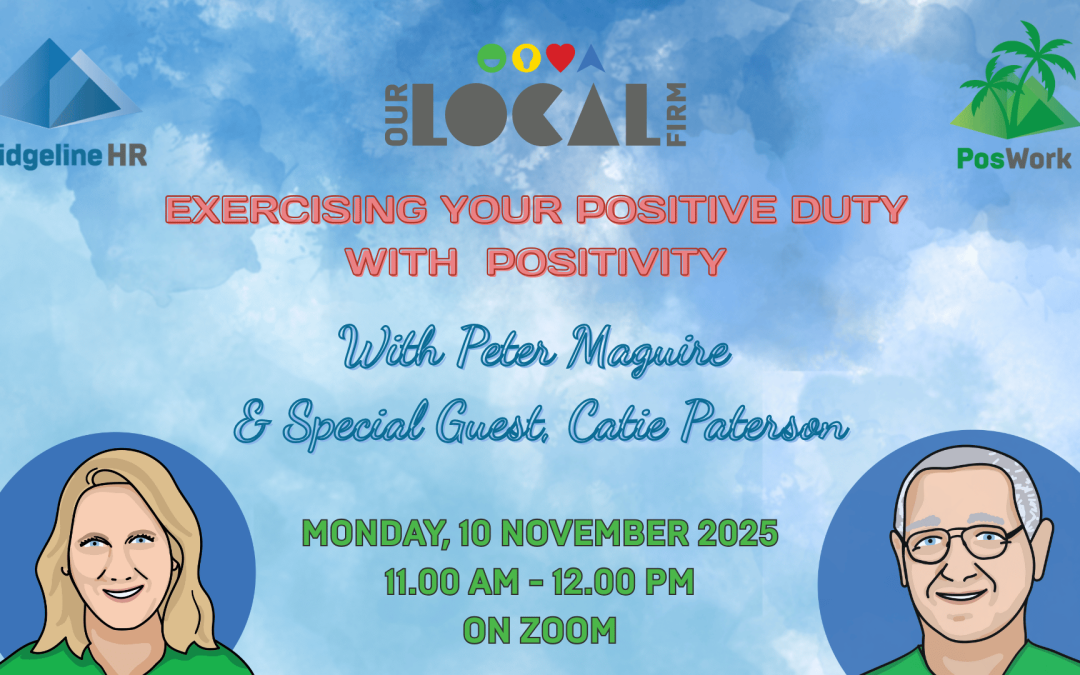
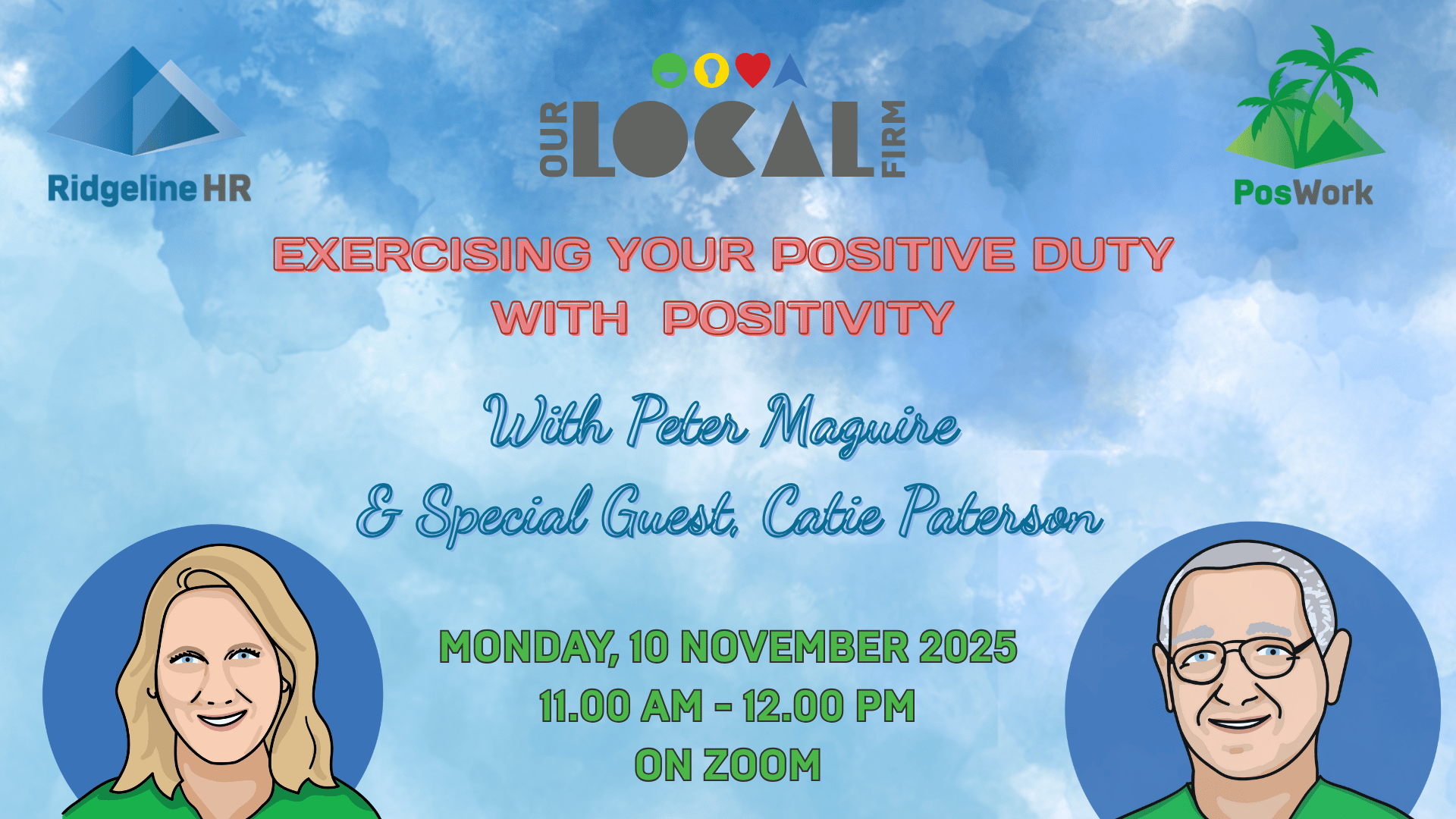
From 1 December 2025, all Victorian businesses have a new positive duty to eliminate or reduce psychosocial hazards and that involves a lot more than just doing a risk assessment and updating your policies. It also provides a great opportunity for business leaders and HR and WHS professionals to generate real and lasting cultural change with strong employee engagement and psychological safety.

Peter Maguire, Practice Leader at Ridgeline HR and PosWork will be discussing this with Catie Paterson from Blue Kite Consulting. They share decades of experience in the HR field and are experts in workplace relations and related compliance as well as in positive psychology based workplace cultures and change management. When you blend all of that together, you’ll get much more than the same old risk management spiel on psychosocial hazards and they’ll teach you how to address the positive duty with positivity using a strengths-based approach with some practical exercises to boot.

DATE

Monday 10 November 2025 11:00 AM – Tuesday 11 November 2025 12:00 PM (UTC+11)

Bookings at https://www.trybooking.com/DGREZ


CONTACT US

Ridgeline Human Resources Pty Ltd
ABN : 24 091 644 094

enquiries@ridgelinehr.com.au

0438 533 311

PARTNER LINKS

TELL US WHAT YOU NEED HELP WITH

Court clarifies annual salary rules

Court clarifies annual salary rules

Latest News & Events

Court clarifies annual salary rules

money changing hands
 For many years, businesses have been paying people on an annualised salary basis using set off clauses in common law contracts to compensate for and set off monetary award entitlements against over award remuneration.  And, a long as people ended up better off overall than they would have been if the award was applied literally, that all seemed fair enough but is it? The Federal Court begs to differ. So what does that all mean?


About this case

This decision by the Federal Court arose from proceedings initiated by the Fair Work Ombudsman and a class action for employees in relation to alleged underpayment of wages by Coles and Woolworths. 

At issue was the question of over how long a period could an employer rely on a set-off provision in an employment contract to effect set-off of and compensation for award entitlements such as minimum wages, allowances, overtime and shift loadings and penalty rates.

In Coles case, the relevant period in the contract was 12 months and in Woolworths it was 6 months. 

There have been cases in the Fair Work Commission where annualised wage arrangements have been inserted in modern awards but the door had always been left open in the related decisions for another gateway via common law contracts.

The General Retail Industry Award 2020 which applies in this case doesn’t have an Annualised Wage Arrangements clause but it is quite specific on this issue in that it states: “Wages must be paid for a pay period according to the number of hours worked by the employee in the period or they may be averaged over a fortnight”. This “averaging” element is consistent with other arrangements across different industries where RDOs and averaging of wages is commonplace.

The judge in this case made the decision that employees have to be paid for hours in the pay period in which they worked them. That invalidated the arrangements that Coles and Woolworths relied on for people to work additional hours in some pay periods and set off the overtime and penalty payments applying to those hours against above award remuneration on other pay periods for up to 6 or 12 months.

So they now each have another considerable set of underpayments of wages to deal with, something that unfortunately happens far too often. 

Record keeping requirements 

A secondary issue that arose was in relation to Coles and Woolworths being found to have not complied with their record keeping obligations.

Specifically, Fair Work Regulations provide that an employer must maintain records of overtime hours worked and the starting and finishing times of overtime hours if a penalty rate of loading applies to those hours.

 It is quite common for people to believe that, if you are on salary, you don’t have to record your working hours. The judge made it clear that having a set-off clause does not exempt employers from other obligations under legislation and regulations and so Coles and Woolworths were obliged to maintain these overtime records and were in breach for not doing so.

The judge’s decision in this regard is consistent with Annual Wage Arrangement clauses where they exist in modern awards in that they require the keeping of records of starting and finishing times and breaks and annual reconciliations of actual hours and remuneration against what entitlements under the award would otherwise have been (ie but for the Annualised Wage Arrangement).

The decision also puts the two employers in a difficult situation in resolving underpayment claims if they don’t have clear records of the days and times that relevant employees actually worked pay period by pay period.

Other considerations

 Firstly, I would note that these major retailers have been trying to find a way around penalty rates for many years going back to WorkChoices which preceded the Fair Work era. The issue resurfaced again recently when employers made application to the Fair Work Commission to have the General Retail Industry Award 2020 varied to provide for a standard loading on minimum rates in compensation for overtime loadings and penalty rates.

The Albanese Government responded with a commitment to outlaw removal of overtime loadings and penalty rates from modern awards by legislation from 1 July 2026.

So the wagons really are circling around these entitlements in government, in the courts and in modern awards.

What do we learn from all of that? 

A few thoughts:

  1. You need to ensure that, if an employee is covered by a modern award or an enterprise agreement, the employee receives their full entitlement to wages, allowances, penalty rates and overtime loadings and any other monetary benefit as per that instrument in every pay period (subject to any averaging arrangement or other variation allowed for in the instrument).
  2. If there is significant variation in different pay periods in the hours of work of an employee who is on an annualised salary (or flat weekly or fortnightly or monthly wage), it is critical that you maintain records of the hours and do the reconciliations to ensure that the employee is not disadvantaged and that you have the evidence to support your position in the event of an underpayment claim.
  3. If you are using set-off clauses in common law contracts, you need to get these reviewed in the context of this decision and the difference that makes in their legal application.
  4. There are a variety of reasons why it is good practice to have accurate records of your employees’ actual (as opposed to notional or contractual) working hours, some of which are legal ones like the ones that have been cited in this case. So, if you aren’t doing that, it is something for you to look at.
  5. You might also find that it is just as easy to pay people an hourly rate and comply with the award in relation to additional payments for extra hours as and when those situations arise.

If you need someone to talk through the issues and options for your business, we would be happy to help.

Please call us on 0438 533 311 or email enquiries@ridgelinehr.com.au if you want to explore how we might be of assistance with any issues like this in your business.


CONTACT US

Ridgeline Human Resources Pty Ltd
ABN : 24 091 644 094

enquiries@ridgelinehr.com.au

0438 533 311

PARTNER LINKS

TELL US WHAT YOU NEED HELP WITH

Fair Work and Safe Work crossover?

Fair Work and Safe Work crossover?

Latest News & Events

Fair Work and Safe Work crossover?

money changing hands
Recently, Safe Work NSW issued a prohibition notice to an employer directing it to pause in a redundancy consultation process because of concerns that it could have been causing psychological harm to workers. Consultation on redundancy situations has generally been in the domain of the Fair Work Commission but now we are seeing a crossover into the workplace health and safety jurisdiction via the positive duty that employers now have to eliminate or control psychosocial hazards, one of which is “poor change management”. What does this development mean?  


About this case

The University of Technology is implementing a cost reduction program planned to run through until 2029.

That potentially involves the loss of 150 or more jobs and the consultation process with employees and unions was underway with staff meetings and the release of the proposed plan scheduled for 3 and 4 September 2025.

On 2 September 2025, a Safe Work Inspector issued a prohibition notice in the belief that UTS workers would be exposed to a “serious and imminent risk of psychological harm” as a result of UTS’s Academic Change Proposal, in contravention of the Work Health and Safety Act and the Work Health and Safety Regulation.

It was reported that Academics at UTS complained of feeling stressed and fearful after the university paused enrolments for a significant number of the courses that they offer.

The prohibition notice was lifted after consultation with Safe Work NSW which resulted in UTS agreeing to allow more time and to consult with Health and Safety Representatives about measures to mitigate risks from psychosocial hazards. 

Our tertiary education sector is undergoing significant challenges associated with program funding, cost competitiveness and commercial viability.

It is also an industry sector which has been plagued with compliance breaches with a string of universities including UTS being required to enter into Enforceable Undertakings with the Fair Work Ombudsman and having to make good on millions of dollars in underpayments to staff. In UTS’s case, that happened in 2023 and amounted to $5.7 million in underpaid entitlements.

And, as is the case at UTS, that sort of culture makes for a significant level of union membership and representation when situations like this arise because there are underlying issues around psychological safety.

What can we learn from this? 

 There are quite a few take aways:

  1. Psychosocial hazards are a hot issue for WHS regulators and the positive duty on employers means that you have to show that you are actively managing them not just reacting when something happens.
  2. The lines between different jurisdictions are becoming increasingly blurred and people are likely to access the one which is going to deliver more timely and forceful impact – a WHS Prohibition Notice is likely going to be quicker and more impactful than a dispute notification to the Fair Work Commission.
  3. Gone are the days when you could just treat consultation as this tick box compliance exercise rather than as a genuine consideration with real employee voice and wellbeing components.
  4. This situation raises questions about the interaction of psychosocial hazards and other complaints on Fair Work matters – for example, would an underpayment of wages also constitute a breach in the psychosocial hazards space (inadequate reward and recognition and poor organisational justice come to mind).
  5. When implementing change which has an impact on people’s jobs, ensure that you follow the Consultation provisions in the relevant industrial instrument and that you genuinely allow sufficient time and proper consideration of employee questions and suggestions and that you respond to them reasonably and with adequate explanation. 
  6. You also need to be giving consideration to the real effects of any changes on people and how you support them individually and collectively through the process.

Change is complicated and something that you would be well advised to get some professional help with – from someone who understands the legal requirements but is also adept in communicating and helping people through the process in as positive a way as possible. 

Please call us on 0438 533 311 or email enquiries@ridgelinehr.com.au if you want to explore how we might be of assistance with any issues like this in your business.


CONTACT US

Ridgeline Human Resources Pty Ltd
ABN : 24 091 644 094

enquiries@ridgelinehr.com.au

0438 533 311

PARTNER LINKS

TELL US WHAT YOU NEED HELP WITH

When future lies elsewhere

When future lies elsewhere

Latest News & Events

When future lies elsewhere

money changing hands
Do you have someone who is a valuable employee but you know it is only a matter of time before they start looking for opportunities in greener pastures for their career growth? How do you deal with that?

Last week, a client asked me about whether they should be doing “Stay Interviews” with their people as distinct from “Exit Interviews”. It is an interesting question and it provided the stimulus for this blog. 

My lived experience

There have been three times in my working life when, upon announcing my resignation to take up a new career opportunity, my boss responded: “Why are you leaving ? We have great plans for you!” And I said: “Sorry but you forgot to tell me about them.”

If we had had those conversations, I might well have been happy to stay and explore the opportunities where I was…..or I might have elected to move on anyway because the opportunities and my needs were not a match.

In either case, we would have both known where things stood and we could plan accordingly with the benefit of that knowledge.

The Reality

The reality for most organisations is that they do not do staff performance and development very well. There might be annual reviews that can feel more like a transaction that we are contractually obliged to complete (ie to tick the box) than a meaningful process for planning and delivering on performance and development goals and job requirements.

Even those which do performance appraisals reasonably well can fall Ito the trap of treating them as an annual event rather than as part of a continuous improvement and engagement process. 

And even where the systems might in theory be appropriate to the exercise, too often managers are not properly trained and equipped to do them or provided with adequate time and prioritisation to get it done properly.

This begs the question of what value the employee gets from the process.

And, in so far as an employee who might be at risk of leaving, their manager might not know (or even not want to know). And sometimes people are so busy in their own world that they can’t see outside that.

So there are all sorts of reasons why a disenchanted employee could fly under the radar and surprises when they say “I’m going”. 

What should happen?

A skilled and  effective manager should be able to have open conversations with their team members about their individual performance and wellbeing not just in their current role but beyond that too.

You should know what the employees’ strengths are and where their future career path is likely to take them.

This should involve an understanding of how far the organisation can support that employee’s career path and where that is likely to end.

For this to happen, you need to be having regular conversations about all of that and have a plan for the employee to execute agreed actions with your support – that can include looking at alternative jobs or projects in the organisation that will help both employer and employee and it can also be about how you can support the employee to take the next step in their career outside your organisation.

The quid quo pro for the employee is that, in return for your support for their career development, they will assist you with succession of their current responsibilities to others

It is all about honesty, transparency and collaboration.

About Stay and Exit Interviews

My ideal is that these are just part of the ongoing performance and development management process through a continuous coaching model rather than stand alone events.

The “Stay” bit is just part of the ongoing conversation in your catchups or is programmed as a specific point of discussion at some stage in the process.

The “Exit” piece can be the final conversation in that process.

Perhaps you want to have an independent person or HR to have a conversation with the exiting employee to get some distance and assure transparency. I get that.

Sometimes, the answers to those questions lie in the reasons that you want to do them………and sometimes they are the very reasons why you shouldn’t do them. I’ll leave that question with you to have a think about.

If you are looking at better ways for you to uncover improvement opportunities with your people practices and culture, that is something that we can help you with.  

Please call us on 0438 533 311 or email enquiries@ridgelinehr.com.au if you want to explore how we might be of assistance.


CONTACT US

Ridgeline Human Resources Pty Ltd
ABN : 24 091 644 094

enquiries@ridgelinehr.com.au

0438 533 311

PARTNER LINKS

TELL US WHAT YOU NEED HELP WITH

Changing the mindset on flexible working

Changing the mindset on flexible working

Latest News & Events

Changing the mindset on flexible working

money changing hands
Is it possible for the parties to the current proceedings in the Fair Work Commission re a model working from home term in modern awards to do other than treat it as a contest between employers and workers?

Sadly, the answer is “no”. Our workplace relations system is designed to be driven by conflict –  by claims and counter claims by employer associations and unions based on opposing ideologies and traditional and political views on how they should represent their constituents in industrial proceedings.

And the Fair Work Commission itself and its members are firmly positioned as the arbiters in that contest as is intended under the Fair Work Act 2009.

What all of that means is that our systems and the positioning of the key parties involved are not conducive to collaboration or to partnering in long-term strategic change. Every case is a transaction in conflict and that is one of the reasons why we have a productivity problem in this country.

So how is that going to deal effectively with issues like “working from home”?

The irony

The COVID pandemic changed the landscape completely because lots of people were not allowed to go to work – they had to work from home if they were going to work at all.

Those circumstances gave rise to some innovative changes to award provisions which allowed employers and employees some additional flexibilities around arrangements with hours of work and use of leave entitlements.

These included temporary options of:

  • varying ordinary hours to operate up to 10.00 pm enabling people to arrange their working hours around their parenting responsibilities and
  • employees being able to schedule their meal and rest breaks to times that suited them rather than the specific times prescribed in the award and
  • being able to utilise annual leave to cover more time off work but at a proportionately reduced pay rate 

Of course, once the COVID lockdowns were over, these flexibilities were removed from awards without any real consideration of whether there might be a case for retaining them.

That was a pity and an opportunity missed because the pandemic lockdowns gave employees the experience of working from home and many liked it and that fundamentally changed how we think about work as part of life. 

So what now?

The Fair Work Commission was tasked last year with undertaking a “Work and Care” review of modern awards and the consideration of “working from home terms in modern awards” is a step in that process.

It is being reported that, as we move further on in time from the pandemic closedown period, more and more employers are demanding more and more workers to return to the office – in some cases full-time and in others for typically 2 or 3 days per week.

The flip side to that is that study after study shows that a majority of people want some flexibility in their working arrangements and, for those whose jobs can be done from home, that is commonly desirable for them. It has become a sought after attribute in employers’ offerings to the labour market.

If you believe the media, employer groups are now advocating the abolition of penalty rates in return for flexibility in hours of work, something which the Federal Government has already pledged to override by protecting penalty rates through legislative change.

It is a bit of a mystery why we don’t simply revisit how the FWC dealt with working from home arrangements during the pandemic – they did do some practical things that seemed to work like allowing an employee and employer to agree to an arrangement of ordinary working hours outside the span of hours in the Award where an employee wants that and the employer is happy to accommodate it. Sure, you might need to make some adjustments to protocols around the right to disconnect in the individual’s case but it really shouldn’t be that hard. 

Some employees have a statutory right to request a flexible working arrangement

Employers now have additional obligations and exposures in relation to requests for flexible working arrangements for workers who have a statutory right to request a flexible working arrangement. These are people who have 12 months service with an employer and:

The odds are that many of your employees fit under one or more of those categories.

Employers now have to genuinely consider and consult with workers about requests for flexible working arrangements, there are strict procedural requirements and timelines involved and a worker who is not happy with an employer’s refusal of their request can take the matter to the Fair Work Commission for mediation, conciliation or arbitration. 

Awards have already been modified to specifically provide for disputes over requests for flexible working arrangements to be dealt with in accordance with dispute settlement provisions in awards.

One of the concerns that employers could have is whether insertion of a working from home clause in Awards would result in in expansion of the right to have a dispute with an employer dealt with by the Fair Work Commission to all award-covered employees rather than just those in the categories that have a statutory right as noted above. Logically, it would have that effect.

So what does all of this mean?

Flexible working and working from home are here to stay.

Employers who continue to resist that will find themselves not just challenged to find and retain the people that they need in a competitive labour market where flexible working is a valued commodity, but will also likely be challenged in the FWC and possibly other jurisdictions to justify that resistance on “reasonable business grounds”.

There are organisations which are more than happy to offer flexible working arrangements because they see the value in them for employees, they equip their organisations with the tools and leadership skills to manage people in those flexible arrangements, they hold people accountable for their performance and behaviour and they actually see improvements in productivity. That is what the future workplace should look like.

So the question that you need to answer for your business is “Do you really want to engage in a tug of war that you can’t win?” 

Please call us on 0438 533 311 or email enquiries@ridgelinehr.com.au if you want to explore how we might be of assistance.


CONTACT US

Ridgeline Human Resources Pty Ltd
ABN : 24 091 644 094

enquiries@ridgelinehr.com.au

0438 533 311

PARTNER LINKS

TELL US WHAT YOU NEED HELP WITH

Dealing with the positive duty to prevent sexual harassment

Dealing with the positive duty to prevent sexual harassment

Latest News & Events

Dealing with the positive duty to prevent sexual harassment

money changing hands
As people will be aware, there has been a huge amount of publicity on the subjects of sexual harassment and gender inequalities in recent times and there are significant changes that have happened or are about to happen in multiple jurisdictions.

Arrival of positive duties

One of those changes is the relatively new positive duty to prevent sexual harassment, sex discrimination and gender-based behaviours which became enforceable under the Commonwealth “Sex Discrimination Act 1984” in December 2023.

The Australian Human Rights Commission has compliance and enforcement powers whereby it can enter workplaces for inspections, interview staff and initiate prosecutions for breach of that positive duty.

We have also seen new positive duties to eliminate or control risks associated with psychosocial hazards which include sexual harassment and gender-based behaviours become operative in most States and Territories of Australia under Workplace Health and Safety laws. It has recently been announced that this will happen in Victoria late this year and there is already a panel of Psychosocial Hazard Worksafe Inspectors operating in Victoria.

What difference do positive duties make?

The traditional approach to dealing with such issues as sexual harassment has been to have a policy to express commitments, procedures for dealing with issues and training to educate people on expectations and then to act on any complaints or breaches reported.

That has proven to be ineffective in preventing sexual harassment.

The positive duty means that organisations now have to conduct risk assessments to determine whether there are any hazards that give rise to risks of sexual harassment and related behaviours and, if there are any such hazards, to implement appropriate control plans, much as has been required for physical WHS risks for many years.

Risk factors in construction

Here are some of the risk factors that are featured in publications by the AHRC:

·       most of your workers are men

·       most of the supervisors or managers in your workplace are men

·       your business involves interacting with third parties (such as clients, customers and/or others)

·       you employ casual staff and/or workers on short-term contracts

·       your workplace is very hierarchical

·       your workplace lacks diversity

·       your workplace is isolated or remote

·       your workplace is divided by gender (for example, women in the office, men ‘on the tools’)

·       alcohol is consumed, especially at work social events

·       you and/or your staff do not understand sex discrimination, sexual harassment, and other unlawful behaviours

·       disrespectful behaviour is generally accepted or common in your workplace

·       you don’t have a policy or code of conduct which sets expected standards of behaviour

·       you have not responded appropriately or held people accountable for unlawful behaviours in the past (or have not applied a policy or code of conduct consistently).

How many of those risk factors are present in your workplace? If you are in civil construction, probably most of them.

The Australian Human Rights Commission Framework

The AHRC has developed a set of 7 standards for complying with the positive duty in preventing and responding to sexual harassment and related behaviours and these are:

1.    Leadership

2.    Culture:

3.    Knowledge

4.    Risk management

5.    Support

6.    Reporting and response

7.    Monitoring, evaluation and transparency

There is some excellent guidance material available at https://humanrights.gov.au

The Leadership Standard

Of those 7 standards, the one that has been called out as the most important is “Leadership” because that is where it all starts.

The standard describes the leadership responsibilities as follows:

1.     Senior leaders understand their obligations under the Sex Discrimination Act and have up-to-date knowledge about relevant unlawful conduct.

2.     Senior leaders are responsible for ensuring that appropriate measures for preventing and responding to relevant unlawful conduct are developed, recorded in writing, communicated to workers and implemented. Senior leaders regularly review the effectiveness of these measures and update workers.

3.     Senior leaders are visible in their commitment to safe, respectful and inclusive workplaces that value diversity and gender equality. They set clear expectations and role model respectful behaviour.

‘Senior leader’ refers to any person with responsibility for the management and governance of the organisation or business.

In a small organisation or business, this will usually be the owner and any manager.

In larger organisations and businesses, this will usually include the board (or equivalent), chief executive officer (CEO), executive leadership team (ELT), partners or executive manager.

Senior leaders hold ultimate responsibility and accountability for the governance and legal compliance of their organisation or business.

They are responsible for their own actions, the actions of those who they lead and influence, allocation of resources, oversight of compliance and shaping the broader workplace culture.

They set the ‘tone from the top’ – meaning that what they say and do gives a strong message to workers about what is acceptable, important and valued.

What the Australian Institute of Company Directors has to say

The Australian Human Rights Commissioner called on the AICD to help in education of directors about sexual harassment, its drivers and things that they need to be doing to meet their duties as directors in this context.

The AICD has developed: “A director’s guide to preventing and responding to sexual harassment at work”. In essence, it follows the 7 standards published by the AHRC. It also notes some really important questions that Boards should be considering including:

·       Do all directors have an adequate understanding of workplace sexual harassment and its drivers?

·       Are you confident directors’ personal communication styles and behaviour model the desired culture?

·       Do you discuss this at board level?

·       Are you comfortable that the board understands the dynamics and prevalence of sexual harassment in the organisation and how it relates to the organisational culture?

·       Does the board, or relevant board committee, consider workplace sexual harassment risks in overall risk management and governance?

So, you can see that the expectations of senior leaders go a long way beyond just putting policies in place – they need to be leading from the front and that starts at board level.

The Queensland development

From 1 March 2025, if a risk has been identified, employers must also implement a comprehensive, written prevention plan that identifies risks, control measures for managing these risks if elimination is not practicable and the process for consulting with employees during its development.

Employers will need to consider specific worker, workplace and work environment characteristics, such as lack of diversity or isolated work, which may heighten the risk of sexual harassment and sex or gendered-based harassment occurring in their workplace.

In essence, this means that any business needs to conduct a risk assessment in line with regulations and the Code of Practice and develop a control plan on how each identified risk will be mitigated.

This applies to all Persons Conducting a Business or Undertaking which has people working in Queensland.

New jurisdictions at the Fair Work Commission

The FWC has been able to issue stop sexual harassment orders for some years, but it isn’t a jurisdiction that saw a lot of activity for the simple reason that, unless the alleged perpetrator was still working in the organisation, there was essentially nothing to stop, and often cases could fail to result in any action on jurisdictional grounds.

If the alleged sexual harassment happened after 6 March 2023, the FWC can also conciliate on sexual harassment disputes and either issue a certificate to allow a court application to proceed or arbitrate itself and has powers to award compensation among other things. 

Conclusion

The challenge starts with senior leadership in our organisations which means, in an industry such as ours, it predominantly starts with the men in those senior leadership roles, whether on boards or executive teams in larger organisations or business owners and managers in smaller ones.

And the process starts with understanding the truths about sexual harassment and gender-based behaviours, what drives them and what impacts they have on people plus what your obligations as a senior leader involve.

Beyond that, it is playing your part individually and collectively to drive the cultural change that is necessary to make the industry a psychologically and emotionally safe place for people and women in particular.

Who is up for that challenge?

This article was originally produced for CCF Victoria’s Bulletin publication.

Please call us on 0438 533 311 or email enquiries@ridgelinehr.com.au if you want to explore how we might be of assistance.


CONTACT US

Ridgeline Human Resources Pty Ltd
ABN : 24 091 644 094

enquiries@ridgelinehr.com.au

0438 533 311

PARTNER LINKS

TELL US WHAT YOU NEED HELP WITH