
Latest News & Events
How coherent is your connection
With the advent of the positive duty to eliminate or reduce psychosocial hazards, an area that has been getting a lot of attention in both Fair Work and Workplace Health and Safety jurisdictions is that of organisational practices on consultation about workplace change and its effects on workers. So what are the obligations, the risks and the practices, good and bad?
The duty to consult
Organisations have had duties to properly consult workers about the introduction of changes under workplace health and safety laws for decades. The same can be said for consultation provisions under modern awards and enterprise agreements in relation to the introduction of changes that affect workers, their jobs and their hours of work. They have been around for a long time.
So why all of a sudden are these provisions in the spotlight?
One is that these duties to consult are now overlapping through the introduction of the positive duty to eliminate or reduce risks from psychosocial hazards. Hazards like poor organisational justice, poor support, low job control and lack of role clarity can all come into play in a poorly designed or executed change management process. In turn, that can lead to disputes in the Fair Work Commission and Workplace Health and Safety Regulator interventions on psychological safety grounds.
Another has been the heightened attention that the Fair Work Commission is paying to the genuineness of consultation in enterprise bargaining processes and the flaws that it is finding that cause an agreement not to be approved on procedural fairness grounds.
That has triggered considerations of exactly what good consultation practice actually looks like and organisations have been found wanting.
Our 4C model of coherence
Why use the term “coherence”?
Because it refers to the state of being logically connected, consistent and easily understood. It describes a situation where different parts fit together to form a unified, sensible whole.
When people complain about communications or change management, it is most often a lack of coherence that they are pointing to eg it wasn’t logical or didn’t make sense to them, it wasn’t consistent or uniform in messaging, it wasn’t easily understood.
Often, the reason is that the organisation is just trying to comply with a duty to consult and/or it is trying to manage a real or perceived risk. That mindset influences both the objectives of the process and the language used in it and those factors can compromise coherence and acceptance.
That then led to the question: “How do we show people how to optimise the effectiveness of change management by building coherence into consultation and communication processes?”
The 4Cs
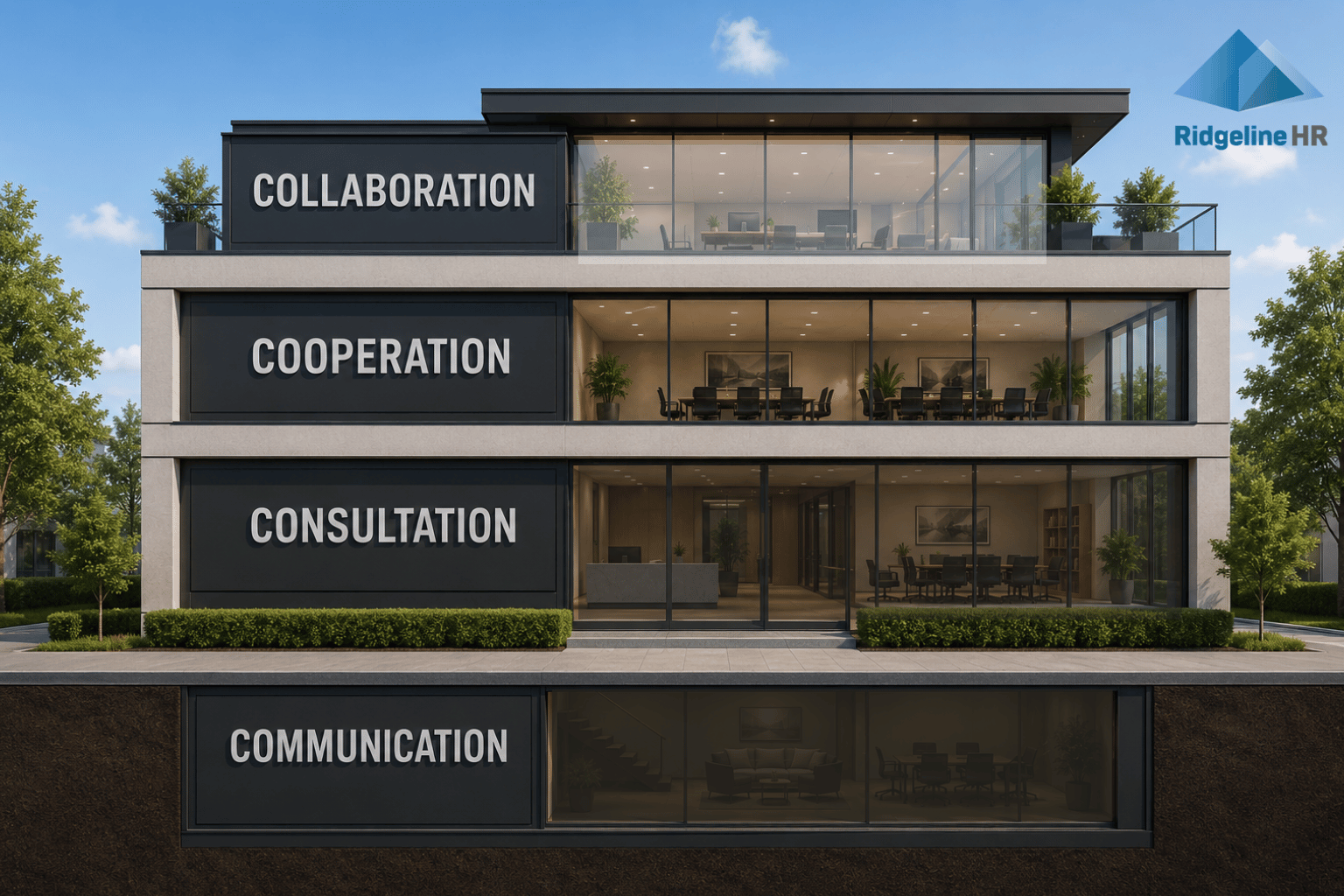
The 4C Model essentially sets out a hierarchy of coherence in consultation and communication processes.
The 4Cs are:
C1: Communication: the base level is where we just tell people that something is happening. It is simply a management direction and doesn’t even satisfy award or statutory obligations in relation to consultation requirements. That makes the level of coherence very low.
C2: Consultation: this is the compliance level; where affected workers are advised about proposed changes and are given the opportunity to consider them, to ask questions and to make representations in relation to the proposed changes and related matters such as how the effects might be mitigated. Results can be dependent on how well explained the changes are and how logical and substantial and real the case for the proposed changes are. If these are not done well (as is often the case), the level of coherence will be low.
C3: Cooperation: this is where consultation and communications are undertaken in accordance with statutory or award compliance but there is also a positive business culture which is centred on transparency and trust. Because workers have confidence in management, they are more likely to accept the validity of changes proposed and to cooperate with management in implementing them. The level of coherence is moderate.
C4: Collaboration: this is the best practice level where management and workers go through a collaborative process of talking about needs for change, working together on solutions, co-designing the change program and co-owning implementation. Employees are part of the whole process from the first question through to the solution and ongoing management and review so the level of coherence is high.
Where do you your change management practices fit on this scale?
How this interacts with positive duties
In Victoria, there are two standards published by government agencies that are relevant, namely:
- WorkSafe Victoria’s Compliance Code: Psychological Health
- Victorian Mentally Healthy Workplaces Framework
The former is the compliance instrument – what the regulator requires Persons Conducting a Business or Undertaking to be doing to eliminate or reduce risks from psychosocial hazards. It spells out the fundamental compliance obligations including the consultation obligations and suggests ways to satisfy them. It is a good starting point consistent with Level C2 to C3 of our 4C model.
The Victorian Mentally Healthy Workplaces Framework was developed as a best practice guide by the Victorian Government in response to recommendations that came out of the Royal Commission into Victoria’s Mental Health System as per the final report tabled in 2021. It advocates a collaborative approach of co-design and a number of other features consistent with level C4 of our 4C model.
Many other components in the framework are highly consistent with our recommended processes for building BETTER workplaces in our PosWork suite of services.
The advantages of adopting the Victorian Mentally Healthy Workplaces Framework as the instrument to guide you in the exercise of the positive duty is that it deals with some of the root causes of risks from psychosocial hazards. It enables this through the redesign of the psychology of the workplace to build psychological safety through positive leadership and collaboration (rather than purely addressing positive duties through a risk management/compliance focus).
How we can help
Whether you need support in undertaking your own psychosocial hazard assessment to identify your strengths and areas for development or you aspire to be a great employer constant with the Victorian Mentally healthy Workplaces Framework, we can help with:
- Tailored workshops and education programs for Boards, leadership groups and workplace improvement teams or safety/consultative committees
- Independent assessment of the business status re psychosocial assets and hazards and provision of independent reports for creation of psychosocial hazard control and business improvement plans
- Establishment, onboarding and facilitation of representative Workplace Improvement Teams to partner with employees in code sign and ongoing management of the workplace improvement agenda
- Creation of engaging communications using multimedia with our Flashtales Creative affiliate
- Coaching HR and WHS professionals in addressing the psychosocial hazard agenda with a positive and creative and inclusive mindset for optimal engagement and results
- Customised programs based on your particular support needs
If you would like to explore ways that we can be of assistance, just fill out the “tell us what you need help with” form below and we’ll give you a call to talk about it.
CONTACT US
Ridgeline Human Resources Pty Ltd
ABN : 24 091 644 094
enquiries@ridgelinehr.com.au
0438 533 311
PARTNER LINKS
QUICK RESOURCE LINKS